
Explore the Rich History, Tribal Heritage, Freedom Movements, and Formation of Jharkhand
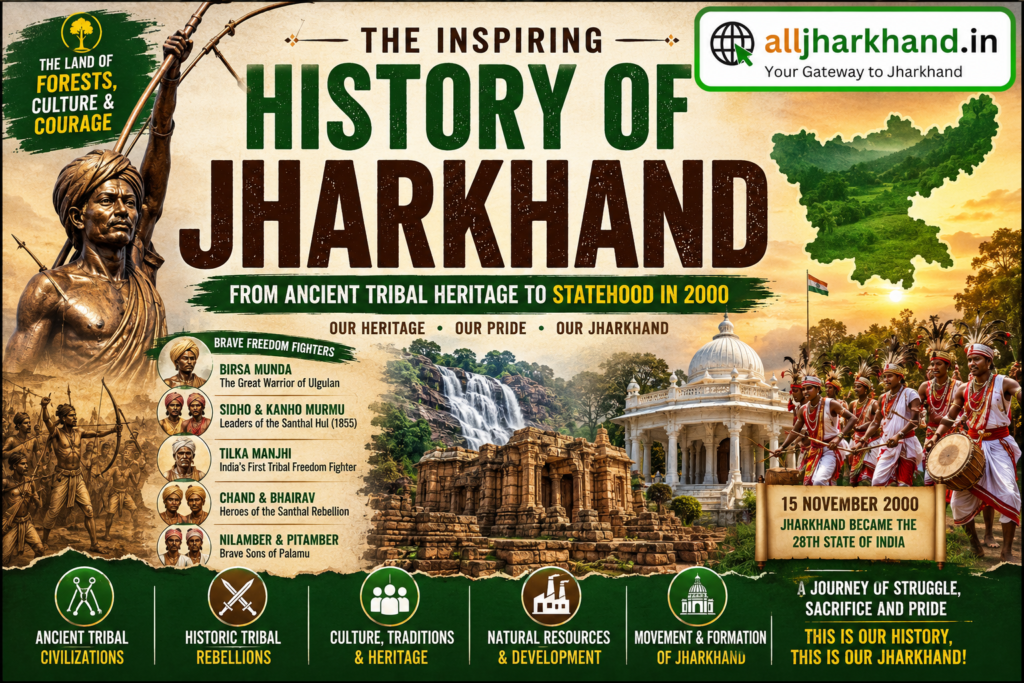
Jharkhand, known as the “Land of Forests,” has a rich and inspiring history that dates back thousands of years. The state is famous for its tribal heritage, freedom movements, natural resources, and the sacrifices of legendary leaders who fought against oppression and injustice. Today, Jharkhand stands as one of India’s most culturally diverse and historically significant states.
Ancient History of Jharkhand
The history of Jharkhand can be traced back to ancient times when the region was inhabited by indigenous tribal communities. The dense forests, hills, and rivers of the Chotanagpur Plateau provided a natural habitat for tribes such as the Munda, Santhal, Ho, Oraon, Kharia, and many others.
Ancient texts referred to this region by various names, including Kark Khand, Kukara, and Chotanagpur. The tribal communities developed unique traditions, customs, and governance systems that continue to influence Jharkhand’s culture today.
Medieval Period
During the medieval era, Jharkhand was ruled by several local dynasties, including the Nagvanshi rulers of Chotanagpur. While many parts of India experienced large-scale invasions and political changes, the forested terrain of Jharkhand allowed tribal communities to preserve much of their traditional way of life.
The region remained relatively independent, with local chiefs and tribal leaders playing important roles in administration and social organization.
British Rule and Tribal Resistance
The arrival of the British East India Company brought significant changes to Jharkhand. Colonial policies, heavy taxation, forced land acquisition, and exploitation of tribal communities led to widespread dissatisfaction.
As a result, Jharkhand became the center of several important tribal uprisings and freedom movements.
Tilka Manjhi’s Rebellion (1784)
Tilka Manjhi is regarded as one of India’s earliest freedom fighters. He led an armed struggle against British rule and inspired future generations to resist colonial oppression.
Kol Rebellion (1831–32)
The Kol Rebellion was a major uprising by tribal communities against exploitative landlords and British administrative policies. It highlighted the growing unrest among indigenous populations.
Santhal Hul (1855–56)
The Santhal Rebellion, led by Sidho Murmu and Kanho Murmu along with Chand and Bhairav, was one of the largest tribal revolts in Indian history. Thousands of Santhals united against British rule and oppressive moneylenders, demanding justice and freedom.
Birsa Munda and the Ulgulan (1899–1900)
One of the most significant chapters in Jharkhand’s history is the Ulgulan (Great Rebellion) led by Bhagwan Birsa Munda. Birsa Munda fought against British policies and the exploitation of tribal lands.
Known as “Dharti Aaba” (Father of the Earth), Birsa Munda became a symbol of tribal pride and resistance. Although he died at a young age, his legacy continues to inspire millions across India.
The Jharkhand Movement
After India’s independence in 1947, the demand for a separate Jharkhand state gained momentum. Tribal leaders and social organizations argued that the region’s unique culture, language, and economic challenges required separate administrative attention.
The movement was led by several prominent leaders and organizations, including the Jharkhand Party under Jaipal Singh Munda. Over the decades, numerous protests, campaigns, and political efforts strengthened the demand for statehood.
Formation of Jharkhand State
After decades of struggle, the Parliament of India passed the Bihar Reorganisation Act in 2000. On 15 November 2000, the birth anniversary of Birsa Munda, Jharkhand officially became the 28th state of India.
The new state was carved out of southern Bihar, with Ranchi designated as the capital city.
The creation of Jharkhand marked a historic achievement for the people of the region and fulfilled a long-standing aspiration for self-governance and development.
Historical Importance of Jharkhand
Jharkhand occupies a special place in Indian history because of:
- Ancient tribal civilizations
- Strong resistance against colonial rule
- Contributions to India’s freedom struggle
- Rich cultural and linguistic diversity
- Historic tribal movements and social reforms
- Significant role in India’s industrial development
Jharkhand Today
Today, Jharkhand is known for its mineral wealth, industries, educational institutions, forests, wildlife, and cultural heritage. While embracing modern development, the state continues to preserve the traditions and values of its tribal communities.
The legacy of leaders such as Birsa Munda, Sidho-Kanho, Tilka Manjhi, and Jaipal Singh Munda remains an integral part of Jharkhand’s identity.
Conclusion
The history of Jharkhand is a story of courage, resilience, cultural pride, and determination. From ancient tribal settlements and historic rebellions to the successful movement for statehood, Jharkhand has played a significant role in shaping India’s social and political landscape. Understanding the history of Jharkhand helps us appreciate the sacrifices, traditions, and achievements that continue to define this remarkable state.